Fabric and Ribbon Wrapped Easter Eggs

Supplies:

  • plastic eggs
  • cotton, polyester, rayon, silk fabric
  • ribbon
  • ModPodge, matte or gloss finish
  • hot glue gun and glue sticks
  • fabric Scissors
  • adornments
  • felt
  • thicker embroidery needles

This project is a great way to use up scraps of ribbons and fabric.  When selecting fabrics, silk-weight fabrics are great because their fluidity works well with the curved surface of the eggs, but quilting cotton is fine as well.  For plastic eggs, I found these large eggs by Creatology at Michael’s and thoroughly enjoyed their eggshell textured surface for good gluing.

I tried a few different ways of decorating the eggs, the first is a basic ribbon wrap.  For these large size of eggs, a standard roll of 9 feet of ribbon was enough to cover the egg.  My first ribbon had double ruffles, and created a wonderful effect on the egg.  I was using up pieces of ribbon, didn’t know if I would have enough, so in this case I started gluing around the midsection of the egg first.

Apply a couple inches of hot glue along the flat center of the ribbon, then press that down onto the surface of the egg.  If eyeing straight lines is not a natural talent of yours, you may want to lightly draw a guideline around the center of the egg to help you start.  After you complete the first rotation, slightly veer the ribbon to one side of your starting point, and continue to glue and wrap towards the tip of the egg.  With this ruffled ribbon, I had to hold back the ruffle of the previous row as I adhered fresh sections so the ruffles did not get stuck under the ribbon, and also to keep the rows laying closely together, to maximize the loft of the ruffles.  When you get to the tip of the egg, place plenty of glue on the surface of the egg, and keep circling the ribbon until there is no more surface space to cover.  If your ribbon is prone to raveling at the end, just compress the width of the ribbon, tuck it under itself by a small amount, and securely glue that down.  Now return to the center of the egg, and wrap ribbon to the other end of the egg.

This turned out to be my favorite of the eggs, because there is a slight squoosh when you hold the egg, it’s such a textural delight.

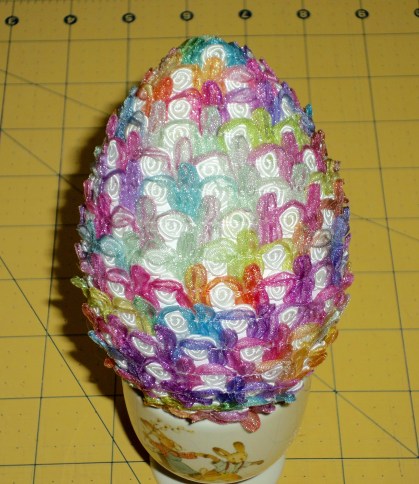
The other ribbon I used had small flourishes above and below the central line of the ribbon.  When you apply the ribbon, keep in mind that these parts will overlap onto the previous row, and you will have to decide which end of the egg to start gluing from in order to create the overlap look that you like.  I was so tickled to have swirls in both the ribbon design as well as the wrapping of the ribbon around the egg!  Notice how I started wrapping at the top of the egg, so the overlap parts point towards the top of the egg.  This reminded me of a pinecone, and of the pineal gland.
SAMSUNG CAMERA PICTURES

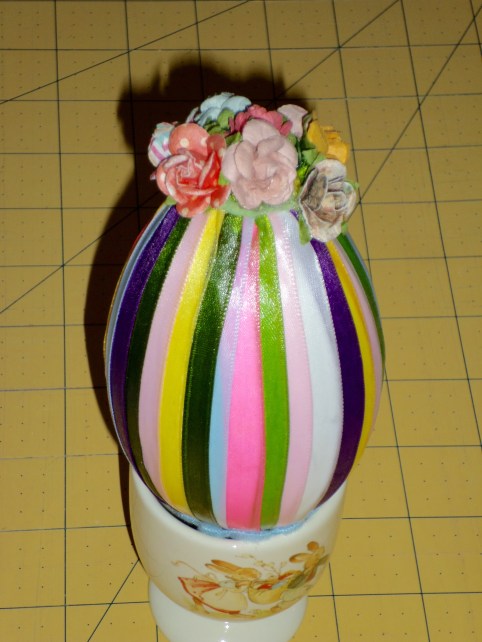
The next ribbon style I tried was way more complicated, but I used up several bits of ribbon, and it ended up having a lovely Springtime in Paris look to it.

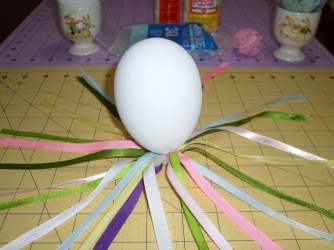
Collect your ribbons, cutting lengths that are about 1-1/2 times the length of the egg from tip to tip. Lay them side by side and make sure that width is enough to cover the circumference of the egg, plus a little more because the ribbons will be overlapping slightly.

Next I cut two small circles of 100% wool felt.  You want to use a felt that is dense enough to hold all the knotted ribbon you are about to pull through it.  If you only have the thinner synthetic felt, do a double layer of the circle.  Now, knot one end of the ribbon and pull it through the felt.  Leave about 1/8 inch around the edge of the felt free of ribbon, as well as the center area of the felt.
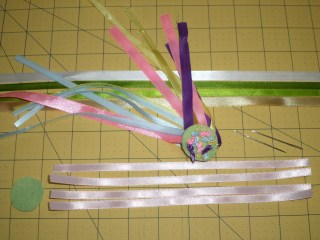
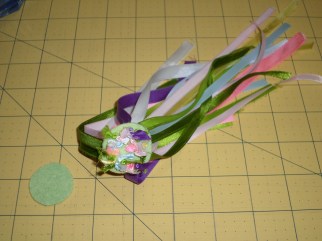
SAMSUNG CAMERA PICTURES    SAMSUNG CAMERA PICTURESOnce your ribbon is all sewn through, lay the felt circle knotted-side down, and splay all the ribbons.  If your ribbons have a shiny side and a dull side, be sure the dull side faces up.  You may have to rotate the knot to make this so.  Be sure the ribbons are as UNcrossed as possible, as it will make gluing them much easier.  When all the ribbons are prepared, slather the top of the egg with hot glue and attach it to the center of the felt circle.  And yes, an octopus comes to mind!
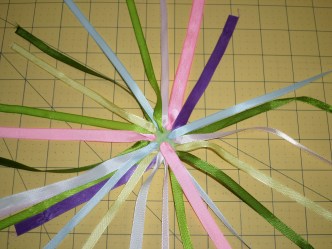
SAMSUNG CAMERA PICTURES  SAMSUNG CAMERA PICTURES

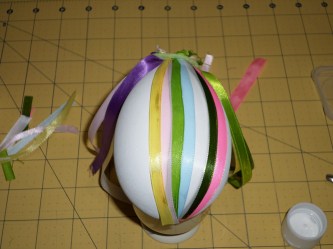
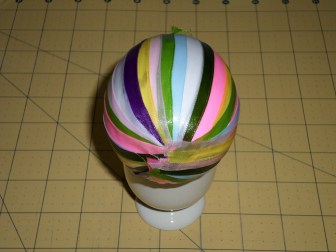
So, if you still have any patience and perseverance left from sorting those ribbons, get ready.  It’s time to start gluing.  Taking one ribbon at a time, brush some Modpodge onto its underside, and carefully align it down to the bottom of the egg.  Take the next ribbon, apply the Podge, and lay it towards the egg bottom so that it just barely overlaps the first ribbon, right at the center, widest part of the egg.  The ribbons will overlap more notably near the top and bottom of the egg, so use how it just barely overlaps in the center as your guide for laying down the ribbon.  Ribbon by ribbon, keep working your way around the egg.  I chose Modpodge rather than hot glue for applying the ribbons because I didn’t want the thickness of the hot glue to ruin the smoothness of the ribbon.  And, if you merely hot glued the bottom end of the ribbon, it would bulk up the bottom end of the egg as well as leave your carefully layered ribbons susceptible to disarray. And, because Modpodge requires time to dry, I only glued about one fourth of the circumference at a time.  Trim off the ends of the ribbon so they centrally align at the bottom.  When you’re done gluing each ribbon, give it time to dry, then paint on a layer of glossy Modpodge around the whole egg (actually, don’t paint the top felt circle.)
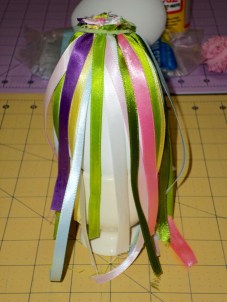
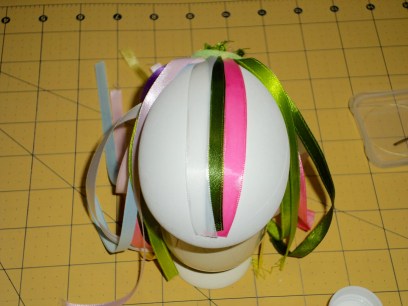
SAMSUNG CAMERA PICTURES  SAMSUNG CAMERA PICTURES

SAMSUNG CAMERA PICTURES  SAMSUNG CAMERA PICTURES

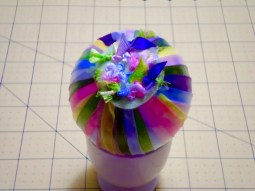
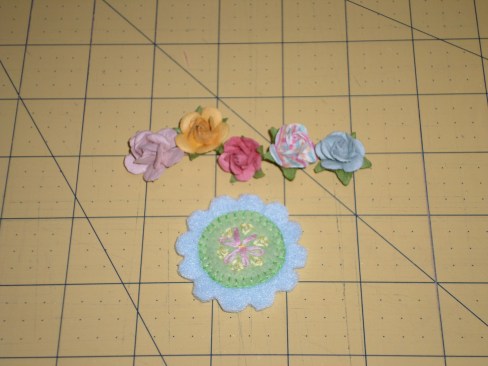
You’re almost done!  Take the second felt circle and hot glue it to the bottom, to cover the ribbon ends.  I added some decorative embroidery to mine.  To cover the knots on the top, I had these little paper flowers on-hand to hot glue onto there.  But little ribbon flowers would be good as well.  You can buy those pre-made or make them yourself.
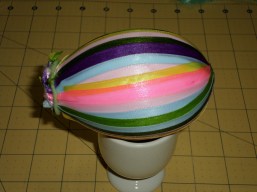
SAMSUNG CAMERA PICTURES SAMSUNG CAMERA PICTURES SAMSUNG CAMERA PICTURES

And, ooo-la-la, you’re done!

SAMSUNG CAMERA PICTURES

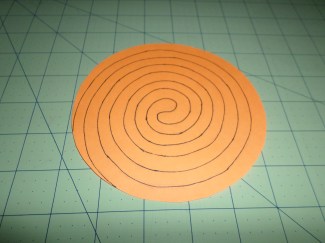
Ok, we’re halfway there.  It’s time for some fabric-wrapping.  The thing that got me started on all this was imagining how well a spiral of fabric could overlay onto an egg.  So I created my template, that of a double-wound spiral.  I traced a circle, then eyeballed drawing a spiral that was about an inch thick, until I neared the center of the circle.  I went back and drew a second line that halved the spiral (so, 1/2 inch thick) and instead of converging the ends to the two lines at the center of the circle, I terminated them in a curl. When the fabric is cut, you have two spirals of fabric.  The size of your staring circle depends on the size of the egg you’re using, an oatmeal canister lid served me well here; a soup can would be a good size for smaller eggs.
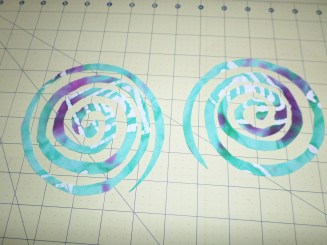
SAMSUNG CAMERA PICTURES  SAMSUNG CAMERA PICTURES

As you adhere the spiral with Modpodge, just do an inch or two at a time.  Start with the center, wind outward.  You want to avoid puckers in the fabric as you wind it, and sometimes your winding will overlap the previous row of fabric, in order to keep it flat.  You will cover about half of the egg with each spiral.


Next, I applied thin curved strips of other fabrics to fill in the gaps and add color and texture.
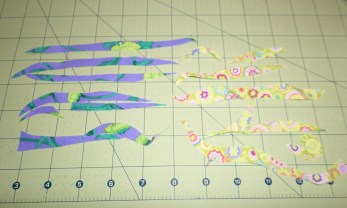
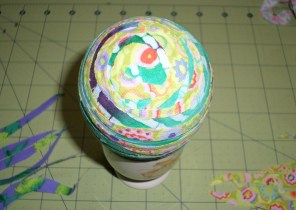
SAMSUNG CAMERA PICTURES  SAMSUNG CAMERA PICTURES

I kept adding strips until the whole egg was covered.  I made one egg with evenly distributed color variance, and one that was half and half (with my filler strips being the same fabric as my spiral.) I added ribbon adornments to finish the eggs.
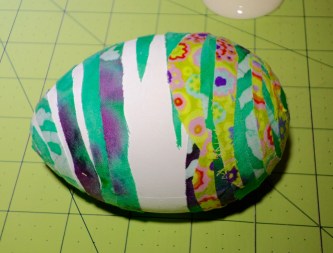
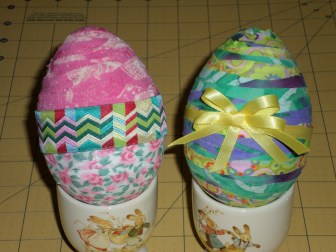
SAMSUNG CAMERA PICTURES  SAMSUNG CAMERA PICTURES

For the fully fabric-wrapped eggs, I cut a rectangle of fabric, wide enough to cover the circumference of the egg, and tall enough to cover from the center of the top point to the center of the bottom. Then I cut triangular wedges from the top and bottom; for the narrower top point I cut taller triangles, for the less-rounded bottom of the egg, I cut stouter triangles.
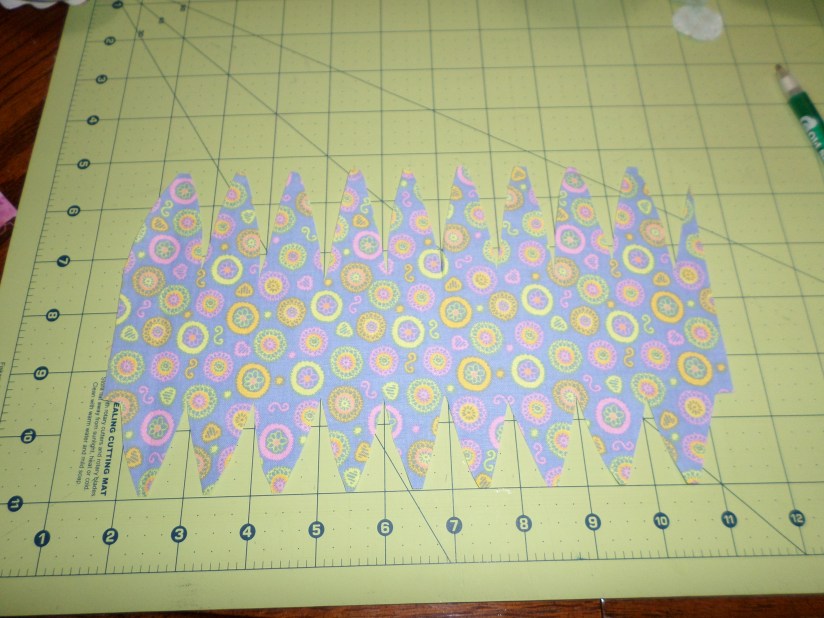
SAMSUNG CAMERA PICTURESModpodge one longitudinal section at a time, carefully overlapping fabric as it curves towards the tips of the egg, and being sure to keep puckers out of the egg.  The advantage of ModPodge is that if you do get a section of fabric that insists on puckering, saturate that area with the glue and smash it as flat as much as possible.  This usually gets the puckers out.  Work your way around the egg until it is fully covered.

Finish decorating the egg with more fabric pieces, ribbons, embroidered decals or even adhesive crystals.

And now we’re done!
SAMSUNG CAMERA PICTURES

The Cosmic [Easter] Egg

863839-comic_egg

I’m still on a spiral kick. There’s just something in my consciousness lately that is interminably walking the labyrinth, and perpetually in motion with spirals and cycles. I keep coming back to things, to myself even, but in new ways. It has been challenging because I am both churning along these vast arcs of time, yet falling through into the eternal hub of cycles that forever iterate the many facets of the One. I have been having a hard time, keeping track of time. But it has been that way for a while now, so I’m actually quite practiced in coping with it. Reading is a great way to cope.

Origin By Dan Brown

Dan Brown’s new book, Origin, has a spiral on the cover (in the US at least). When you see an image of a spiral, it is both leading somewhere (in or out, depending on your perspective) yet is self-contained by its own circumference. It’s a brilliant way of letting you know, that you are only ever going anywhere to experience how you already got there. The spiral is one of the most ancient and ubiquitous symbols used by humanity, insistently etched into stones all over the planet, and it is still a mystery to the modern mind as to where they were going with it. Only Time will tell.

When it comes to plumbing the depths of ancient and superimposed symbols, you can’t do better than Easter. Anyone who’s ever breathed importance upon Springtime, Rebirth, Resurrection, Renewal has dipped their toe into the well of Easter symbols and enjoyed the ripple of how they ultimately tell the story of “YES!”

It occurred to me for the first time just this past week, how the whole psychology of Eastertime must be different for those living in the Southern Hemisphere. Is it more religion-focused, less season-based? And how does it affect their experience of religion, if Jesus resurrects into the autumnal, dying time of the year, rather than the vernal rebirth of it? Does it change what is understood of the Resurrection, when one’s outer world is doing the opposite of what is being celebrated at this time of year? Does it give a greater insight into the nature of winter? I need to investigate, are there even many climates in the Southern Hemisphere that reflect the same seasonal changes as we experience with deciduous forests in the North. I welcome any feedback, because I’d like to know.

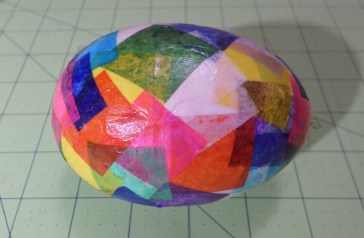
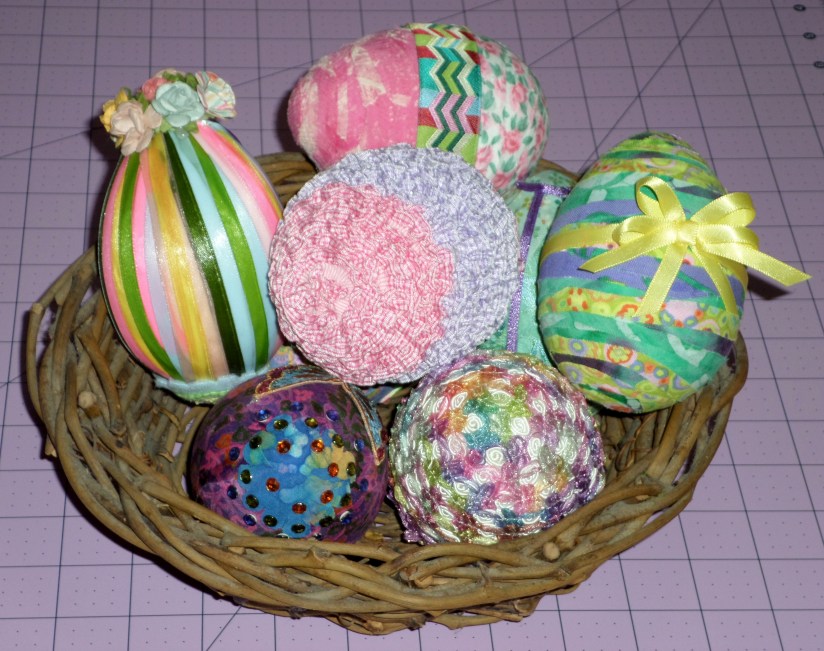
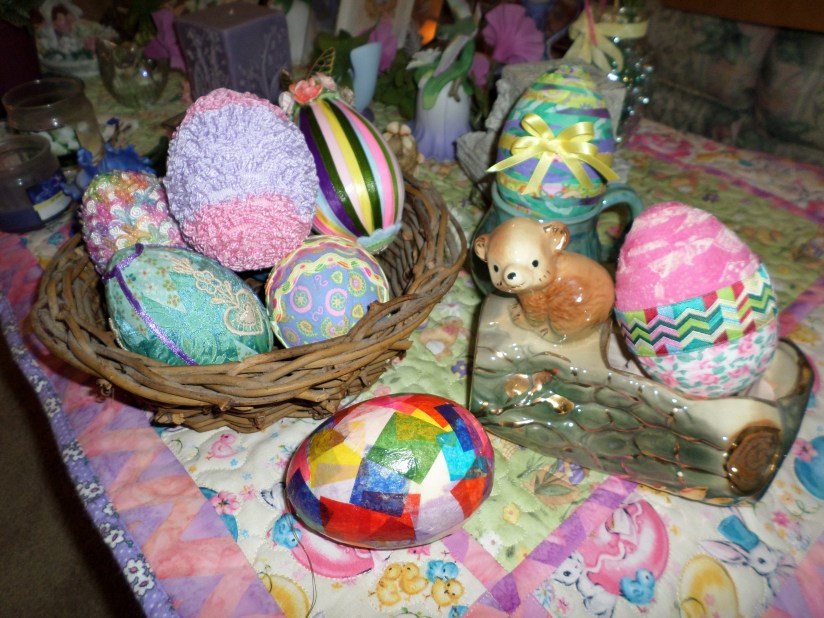
Anyway, I’ve been spiraling towards Easter with deep thoughts and springy, creative juices. While putting away Christmas/winter decorations, I found an old art project I made in 4th grade. I’m sure many of you made these too. We used the plastic egg our mother’s pantyhose came in, and shellacked a bunch of tissue paper squares onto it. Mine is over 35 years old, and has held up well. It was inspiring to see it endure with sheen-in-tact. So, I decided I wanted to make some fabric-wrapped eggs. It was time for more spirals in form and action. I gathered the accouterments (hello ModPodge!), took a deep breath into the heart of Time and Creation, and watched how it all coalesced into the birth of the Great Cosmic (Easter) Egg. Actually, the birth of 8 Great Cosmic (Easter) Eggs, 8 origins of 8 worlds to call my own, (and to display nicely on my coffee table.) Talk about symbols – lay them all out and it’s like taking a walk through infinity.

SAMSUNG CAMERA PICTURES


Coming soon, instructions for Fabric and Ribbon Wrapped Easter Eggs.

SAMSUNG CAMERA PICTURES

Fabric-Wrapped Clothesline Quarter Holder

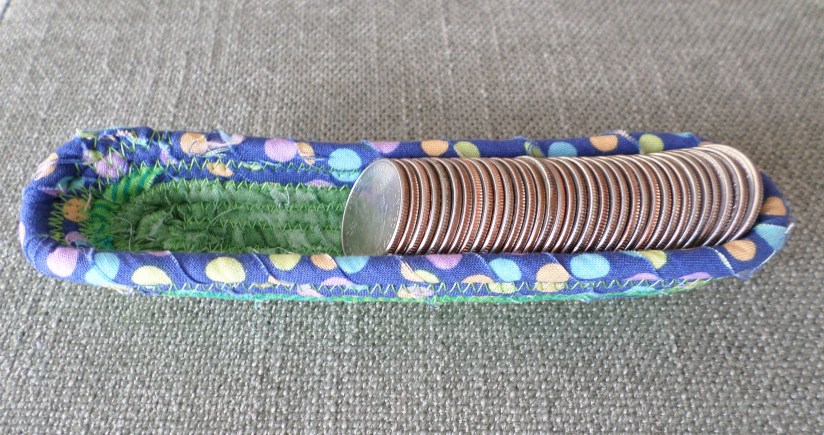
I live in an apartment and require a great many quarters to do my laundry.  I’m in the habit of getting a roll of quarters at a time, and I’ve been keeping them in a small tupperware container.  It’s a perfectly fine system, but I decided I wanted an easier way of seeing how many quarters I have on-hand, as well as of plucking out however many I need to take to the laundry room.  Plus, I wanted a quick and easy way to appease my Crafty.

Please refer to the original Fabric-Wrapped Clothesline Bowl post for detailed directions on how to work with these materials.  However, here is a mosaic to show my start in how to shape this sort of thing, as well as my successful result.  I used three long widths of cording as the base, then steeply angled two rows, then finished with a final two rows.  It all feels so…tidy!

SAMSUNG CAMERA PICTURES

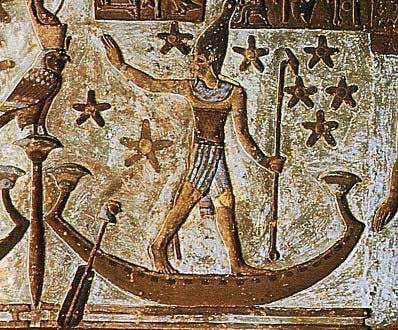
What I really love about this is that when I hold it, there is something about the heft of the quarters, and the way they are cradled, that transports me to ancient Egypt.  I feel the steady and quiet soar of Ra’s Solar Boat.  In patience and perseverance it spans the skies to define our day, then traverses the Underworld and its challenging darknesses at night. I am grateful to say, my trips the the basement laundry room hold no threat (other than the occasional sacrificed quarter to an uncooperative machine). Here’s to our safe delivery through each and every day….

Here’s some basic info on Ra’s Solar Barges.

egyptsolarbargeosiris

Things Get Served on a Platter

In my last post, I mentioned that I need to get a canvas to do some painting, and this showed up in my inbox today.  I’ve done their Sketchbook Project before, and this sounds fun too!

https://www.brooklynartlibrary.com/canvasproject

I just love it when the energies serve me!

BTW, here’s a link to the digitized sketchbook that I submitted, the theme we had to work with was “Message from a Future Self”:

https://www.sketchbookproject.com/library/17333


Making Use of the Negative Space, part 2


In the first part of this train of thought, I mostly focused on how you remove layers to reveal your truth in art or in living. This wonderful video and artist sort of blows that thinking apart. Something I insinuated before is that truth has a final moment/stage/outcome, and it is just a matter of sifting through the filler space until you identify that truth. But, as seen above, when we participate in a living space, truth can only exist throughout the moments in which you recognize it. Trying to freeze a truth in a moment of time may kill the journey it has to take, along with the creativity that explores it.

As artists and crafters we have the assumption that there will be a finished product, even if it is an expressive product like choreography or a play. There is always a point where we reflect upon the thing and say, “Yes, it is done.” (Or at least, “This is the best I can do.”) Our cultural stereotypes of artists seem to have them suffering from both starvation and lingering doubt over whether it ever truly is done, (even when the masses pay big money to see that very incarnation of that very thing YOU made.) Is it done? Even if you feel totally fulfilled by your creation during a moment in time, give it a few years and you will be ready to see the other scenes you could have shown, or the other stories you could have told (thank you, fan fiction).

Do you remember after the Harry Potter series ended, we eventually found out that Dumbledore was gay, and that Harry really should have ended up with Hermione? J. K. Rowling can go on to explore other stories and realities, but she will never be done with Harry’s world (and yes, partially because the fans will never let her be done.) If you are both blessed enough and cursed enough to vividly create a whole world, exploration of that world will never end. The world beckons and there is always another story to tell.

So, back to Rassouli and his moving, living art. Even when this infinite world is on a finite canvas, here we go diving through moments of time and layers of truth. This artist shows us how to pause for a moment, appreciate the perfection of what currently is, then let it all go. In watching the video I kept having moments of anticipation of where the image was heading, then being surprised about where it went. And certainly, there were little anguished moments of not wanting to see the current image morph, because it was perfect as it was. It takes courage to allow the perfect moments to pass, along with the unsavory ones. I have read that in the mythologies, whenever a god falls in love with a human, it is the eternal falling in love with a moment in time. I often create things that I simply fall in love with, and because of the color or texture or shape of the thing, it counts as being a sensual love. But do I have the courage to keep creating that thing, and to allow it to transform completely? Is there such a thing as over-creating?

I imagine there is a safety in creating a series, because each piece is part of the greater story. No single incarnation has to be sacrificed or hidden into the layers, you just create a new piece and let that be the next evolution. But what if I as the creator and witness of a piece, can sustain the expression of all the layers through memory and depth? Will I become the story, by acting out the experience of the story? And is the story any less true if it doesn’t become a permanent expression of who I am?

There are a lot of artistic materials that are impractical for constant reworking ; painting is probably the best form for exploring this. I plan to start my own painting and see if I can simply allow it to keep living in the state of ‘being created.” I’ll share photos as I do – but first I need to get a canvas.

Making Use of the Negative Space, part 1

A few days ago my enthrallment level went high and stayed high, after seeing this video. Neolithic Goddess figurines are so much better to play with than Barbies, and always have been.

I watched the video several times, each time loving more how the artist turned immortal images of stone into supple and fleshy dancers, and how it all was so natural. So I went on a quest, first to youtube to see Nina Paley’s other videos, then to Wikipedia for her bio. While there, I crossed an acronym I’d never heard of before and decided to investigate. And that’s what led me down an hours-long rabbit hole research into discovering a vast world of words, definitions, faux antitheses and scathing contentions, in this particular case between transgender and feminist communities.

It was fascinating, reading the vitriol and antagonisms that flourish so quickly these days, thanks to social media.   And the acrimony (so supple in its attentions), and rancor (so fleshy in it wallops), and angst (lo! the heaving bosoms), all in what is ultimately distraction and name-calling, Really, it was fascinating, and I got to thinking about objections and negativity, and objects and negative space.

When creating any scene, you have to decide things, like: will the objects take precedence, will the negative space (background) be your actual focus, how will you use the negative space to define the objects, will you use patterns to differentiate the objects from their space, will you soften the objects so the space can be seen as an entirety. You have to be able to imagine many layers of the scene you’re creating, and a practiced creator knows how to interrelate those layers in order to fulfill the scene you want it to be.

In carving those goddess figures, the ancient artists needed to remove the negative space from the stone, in order to reveal the divine image it held. In creating a relief carving, the slightly less-ancient artists needed to know how to remove planes of existence to find their chosen divine images. Knowing how to remove the negative spaces to reveal the highest form (the divine aspect) is the talent of the Artist. Had those artists been warriors, they would have thrown the stones as their means of making a statement. Had those artists been great leaders, they would have insisted on using those walls and planes as an engulfing form of defense and power. Protection has its value, but how often does it reveal the divine?

The Artist, and to greater effect the Creator, (both born of you or me,) are the ones who know how to dialog with their mediums. Whether they are working with paint or stone or words or communities of people, it is the creative aspect that knows how to see through all the negative space and strip away the unnecessary in order to show the stark divinity (i.e. highest potential) of any given form. And this knowingness of what can be found is ancient, in you or me. Any form that presents itself to our attention, is the invitation to become creative, see into it, and decide which level of it you will reveal, which level you will call truth.