Fabric-Sheathed Clothesline Rug

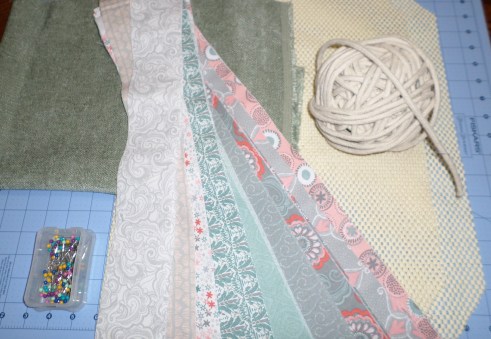
Supplies:

  • fabric jelly roll
  • thread
  • no-skid backing the size of your rug
  • durable (thicker, like canvas) base fabric, size of rug
  • durable fabric (same or different from base fabric) enough to have strips that bind the edges of the rug
  • pins
  • cotton clothesline
  • sewing machine with a zipper foot


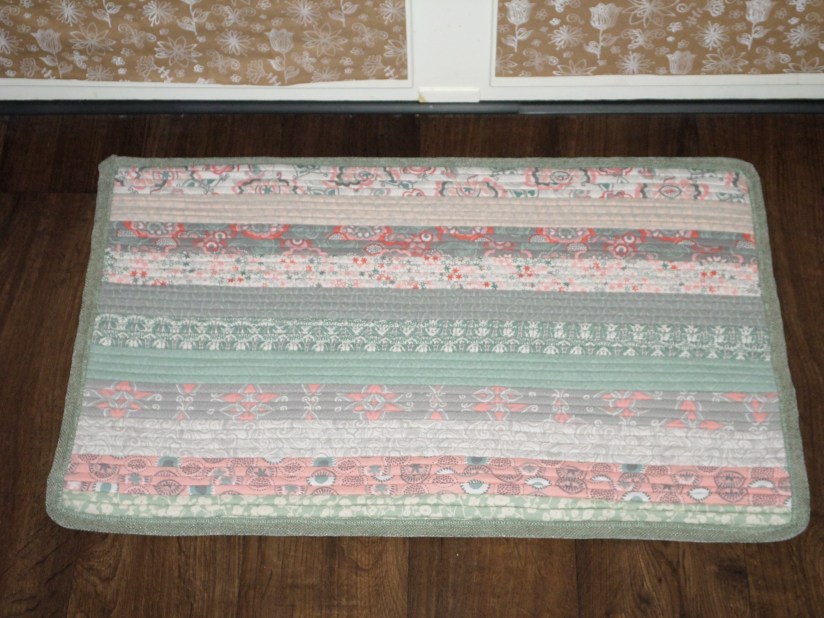
The size of my rug was determined by the size of no-skid backing I happened to have on-hand. The finished size of my example is about 28 inches wide by 18 inches high.
SAMSUNG CAMERA PICTURES

I unrolled and arrayed the fabric strips to decide what order I wanted them in.  Then I cut lengths of clothesline that were slightly longer than the length of rug; 2 lengths of clothesline were used per row that you sew (this equals about 3/8 inch width). So that means 4 lengths of clothesline were used per fabric strip.

AN IMPORTANT NOTE: My photos show that I laid the clothesline short of the edges.  PLEASE IGNORE THAT, and let your clothesline extend just past the edges.  I originally tried to create a 1/2 inch seam allowance on all sides, and for a variety of reasons, abandoned that idea.

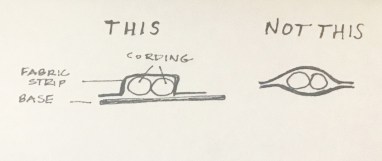
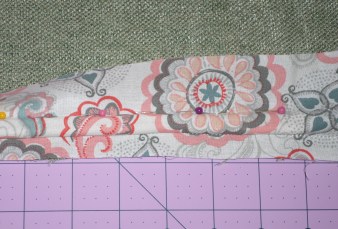
First sew a strip, right side up, along the length edge of the base fabric, with a 1/2 inch seam allowance.  Now align two cords of clothesline, side-by-side, between strip and base fabric, pin tightly.
SAMSUNG CAMERA PICTURES IMG_0617

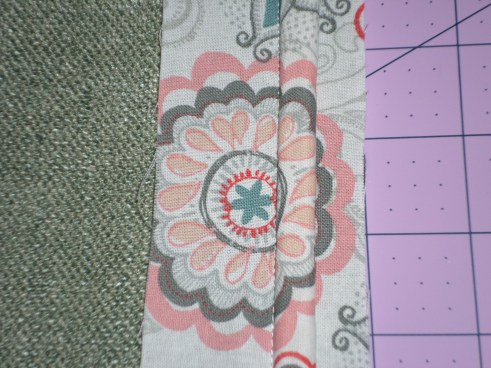
Using a zipper foot, press side of cords against the foot and sew.
SAMSUNG CAMERA PICTURES
first sewn row of rug, fabric should be fairly tight over cording

Align the next two cords, pin the fabric tightly over them, then sew.  Jelly roll strips are 2.5 inches, so you get two rows of cordings per strip. It is possible to get three rows of cording per strip, but that would leave only slight seam allowances on each side of the fabric strip, and I think the rug would wear out faster.
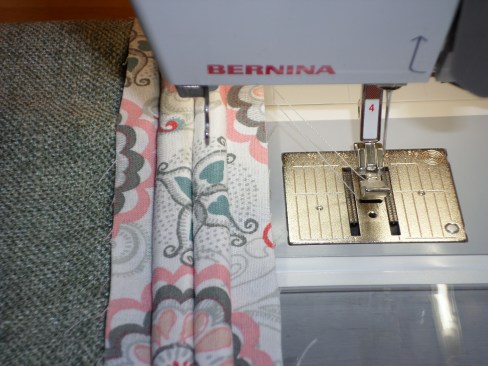
SAMSUNG CAMERA PICTURES
two rows of cording, one strip of fabric

Lay the next strip of fabric, face down, so that you have a 1/2 inch seam allowance from the row you just sewed.  Attach to the base fabric – you are basically sewing over the last row you sewed. I placed a pin at the start of the row, then used my finger to make sure the new strip of fabric stayed straight as I sewed it.  It is IMPORTANT that as you sew each strip/row that it butts up against the previous row, you want almost compressed rows.

Align the next two cords, pin fabric tightly over them, then sew.  Continue doing this until you have filled the width of your rug, being sure there is a 1/2 inch seam allowance remaining on the base fabric.

SAMSUNG CAMERA PICTURES
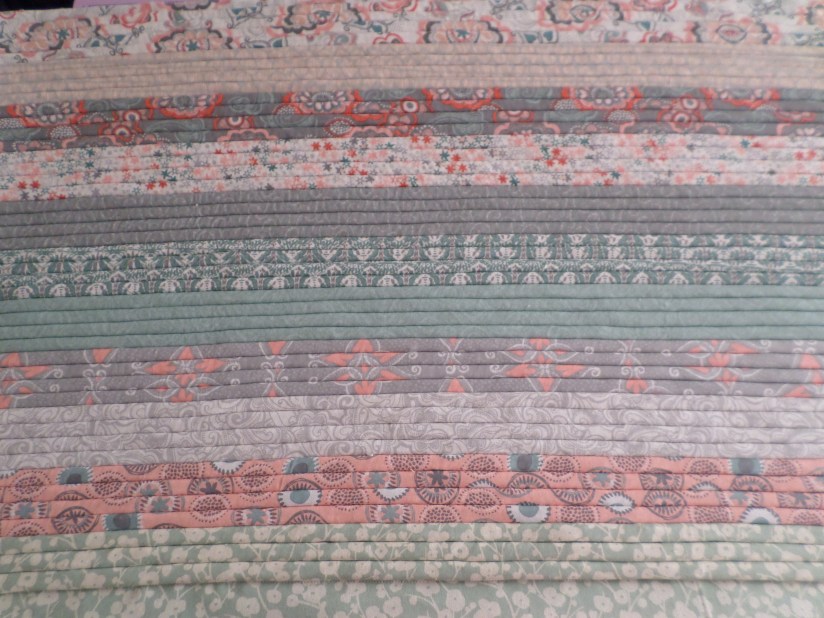
I did 4 rows per fabric design (so 2 strips of each design used)

With the bottom of the rug facing up, lay the no-skid layer down, and pin the edges. Trim the cording and fabric along the raw edges so they are even with the base fabric edge and straight.
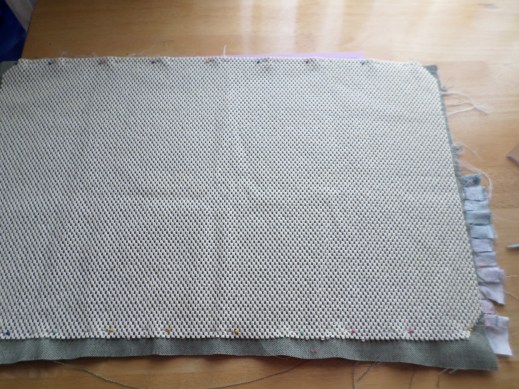
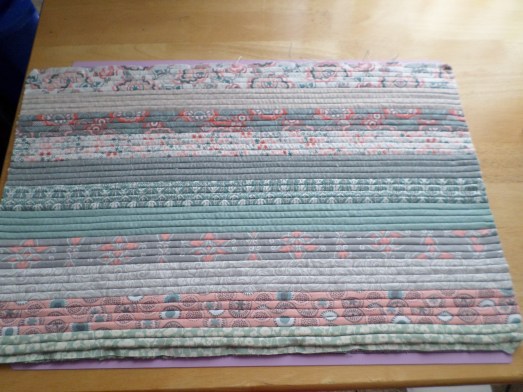
SAMSUNG CAMERA PICTURES

SAMSUNG CAMERA PICTURES

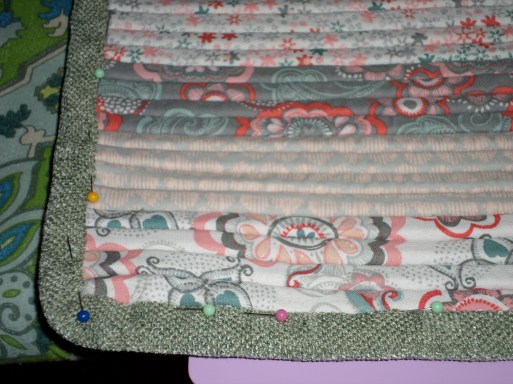
Prepare your binding, a 2.5 inch strip long enough to cover all four edges of the rug. I used the remainder of what I used as my base fabric (a seafoam colored chenille woven fabric) and I had to seam my strip together a few times because the pieces of fabric I had left were short.  Pin the binding along a length edge, starting in corner.  Work around with pinning the binding so ends meet at original corner.
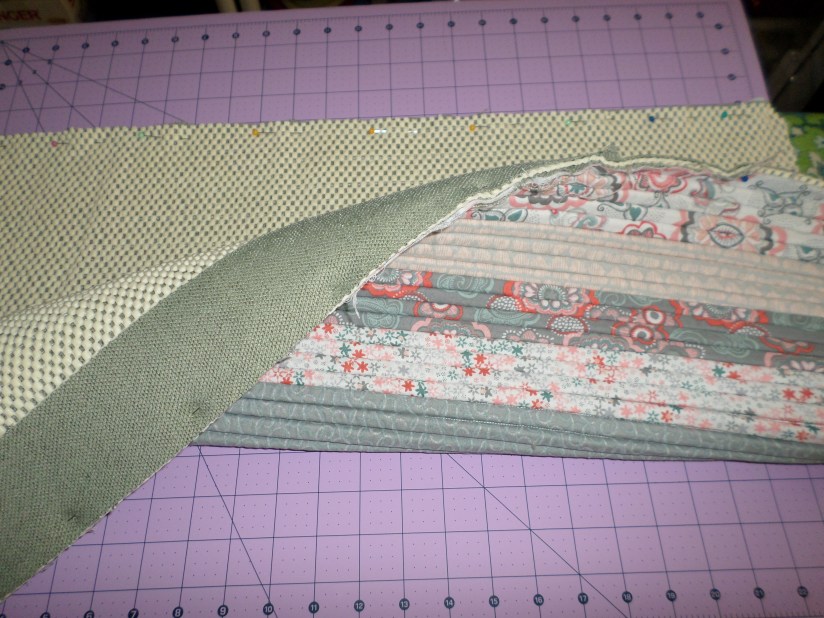
SAMSUNG CAMERA PICTURES
pins run through the binding strip, no-skid layer, and base fabric


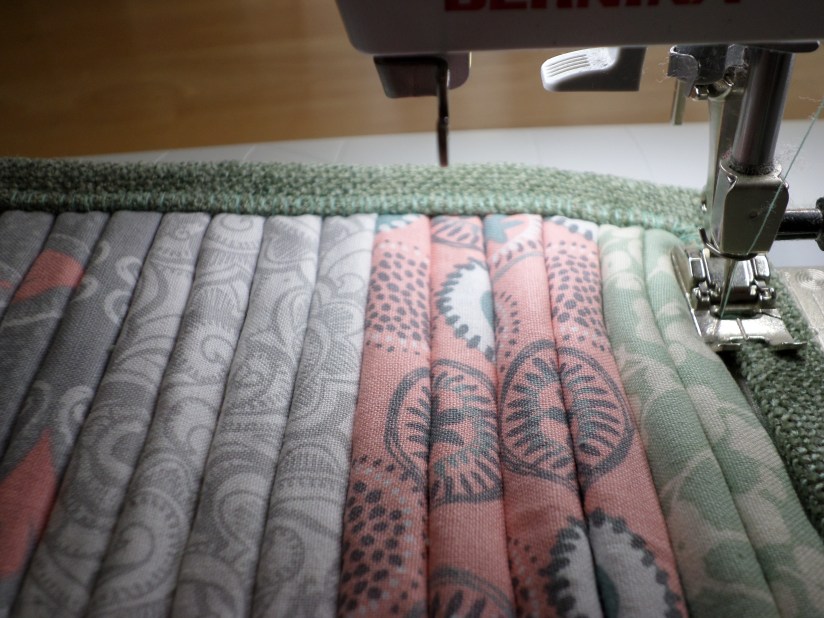
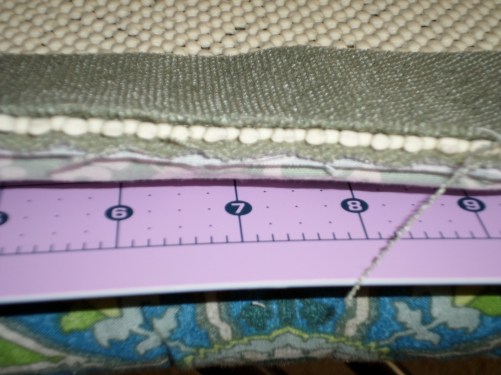
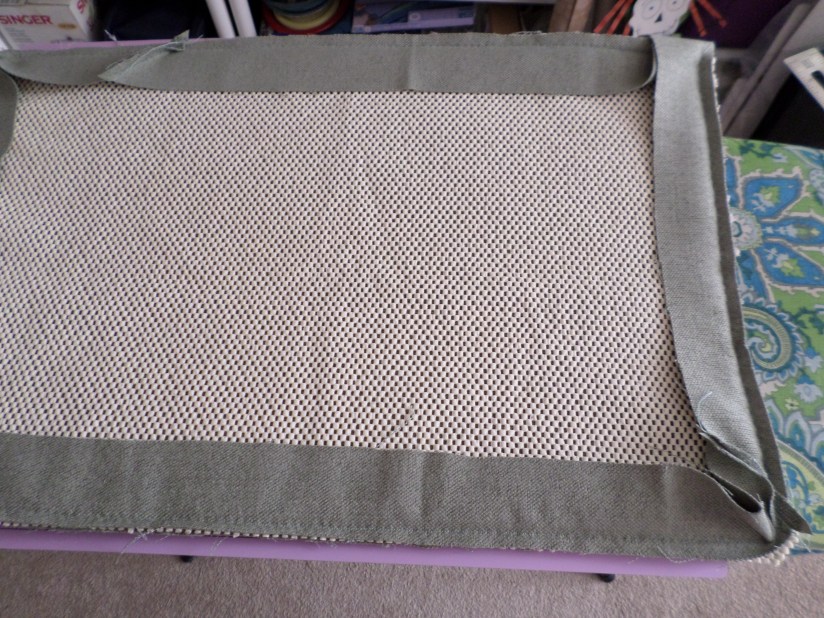
With the rug face up, sew binding on with a 1/2 seam allowance all around.  Be sure to use a needle that can handle the thickness of the cording on the short ends – sew slower to ensure this.
SAMSUNG CAMERA PICTURES

SAMSUNG CAMERA PICTURES
sewn edges, bottom corner binding edges left apart

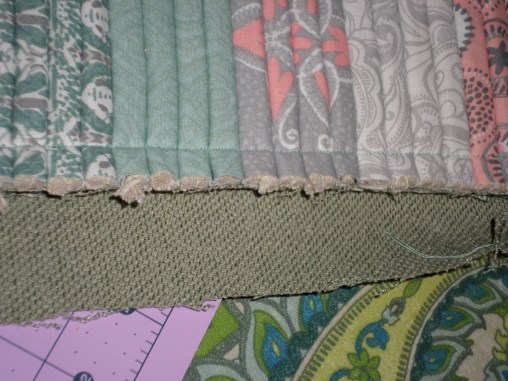
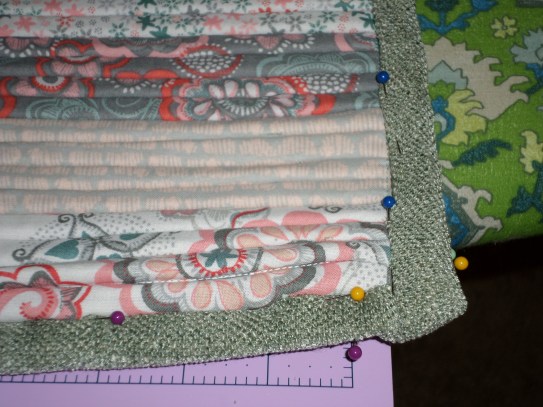
Fold the binding over to the front of the rug, turn it under so the top binding is about 1/2 inch wide and pin all around.  Miter the corners by using folds and extra pins to hold corner in place.
SAMSUNG CAMERA PICTURES

SAMSUNG CAMERA PICTURES

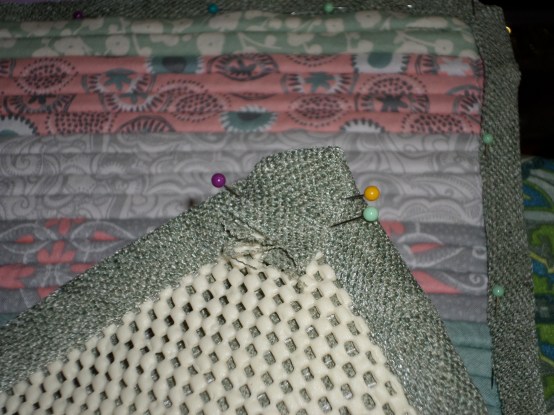
At the starting/final corner, trim binding even to one edge of the rug, then fold the other end of binding to secure the cut edge, and fold to bottom of rug.  Sew all around (I used a blanket stitch), again, going a little slower as you sew through the thicker cut-cording ends of the rug. Securely machine sew this starting/final corner, and then tamp down any missed edges with hand sewing for extra security.
SAMSUNG CAMERA PICTURES

SAMSUNG CAMERA PICTURES

SAMSUNG CAMERA PICTURES
I used a blanket stitch to better secure the binding

Tie off and secure and final threads, and then you’re done!  Because the space between each row forms a little ditch, I recommend using this rug in the bathroom or kitchen, since dirt from shoes will easily get trapped in those ditches.
sam_0456.jpg
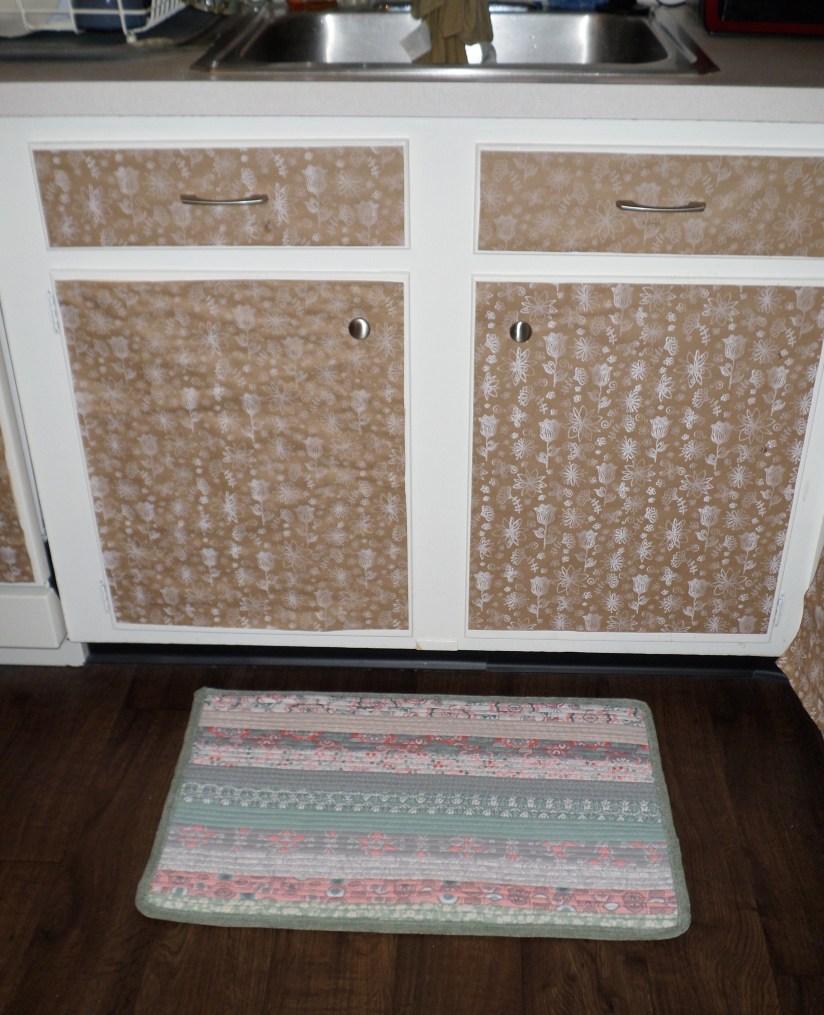
Now I can wash dishes in comfort.

Time and Again, But Wait, No

12

I’ve tripped into another rabbit hole and this one is really sticking with me.  I heard a reference to the “Mandela Effect”, and so went to youtube to investigate.  I found oodles of videos explaining it, and giving examples of it.  The Effect is basically that there are large groups of people who have specific memories about things (historical events, spellings, quotes, logos) that evidently, never were true.  It is considered to be about timelines that are actively altering, and is often blamed on what CERN has been up to.

I have no idea where the truth lies (a favorite oxymoron, and learn its grammar here ) but I do know I got sucked into the potentials.  I remember Jiffy peanut butter, it was “Luke, I am your father,” I know it was Dr. Bragg’s apple cider vinegar, and there is no way Jean-Luc Picard fiddled with some random decor crystal in over 70 episodes of Star Trek: TNG.  I loved Jean-Luc and crystals too much at the time to have overlooked something like that.

All of this has got my brain scrambled.  Which isn’t such a bad thing, since creativity benefits from out-of-the-brain* thinking.  So how am I unwinding from all of this? How can I straighten out these tangled time threads? How can I ground out all this instability and chaos?  Well, I can make a rug.  I could use a rug.  I’m going to just get really anchored in my Now moment, and make a rug.

I’ve had some fabric jelly rolls I’ve been meaning to use (at least in my current supposition about my past, I have them, and have meant to use them.) I decided to also use some of that wonderful cotton clothesline that is left from my other recent projects (see my Projects page).  Touring the internet for ‘clothesline jelly roll rugs” I found two concepts that appealed to me.  One incorporated no-skid backing and had a woven look to it, the other had a classic rag-rug look that I like.  I opted to design my own rug, and answer my own questions.

Starting with the wonderful, eternal  spiral of a fabric jelly roll,  I’m going to unwind it, straighten out the strips and align them all in a nice, finite way that my mind can comprehend, and my feet can stand upon.  I will have a lovely center point from which I can let go of my attachment to the past and go-with-the-flow to enjoy my future.  This launch into researching the Mandela Effect may have me trippin’ but my new no-skid backed rug won’t.

SAMSUNG CAMERA PICTURES

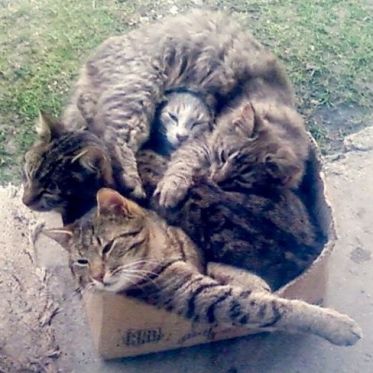
* Thank you Mandela Effect. For those of you who remember “out-of-the-box” thinking, that only applies to Schrödinger’s cat now. Cats in general, actually. **

Do you remember the Great Box Shortage of 2018?

4876cd9188e14cfaa7dc16db531a5297--crazy-cat-lady-crazy-cats


** Ok, I just made that up.

Instructions for Fabric-Sheathed Clothesline Rug, on the way…really, in all timelines, on the way.

Interlude – Essential Truths, and Needle-Felting

The evolution continues.  In a two-part previous post I used the word ‘truth’ to reference that core perception that an Artist uses, around which she builds her expressions (i.e. art,  and the messages contained therein.)  Well, with this latest Interlude, I got to explore the difference between what we would see as the truth of a thing, and what we would see as it’s essence.  It’s subtle, (and could easily be merely a point of semantics), but telling in how we lead a viewer into perceiving our creations.

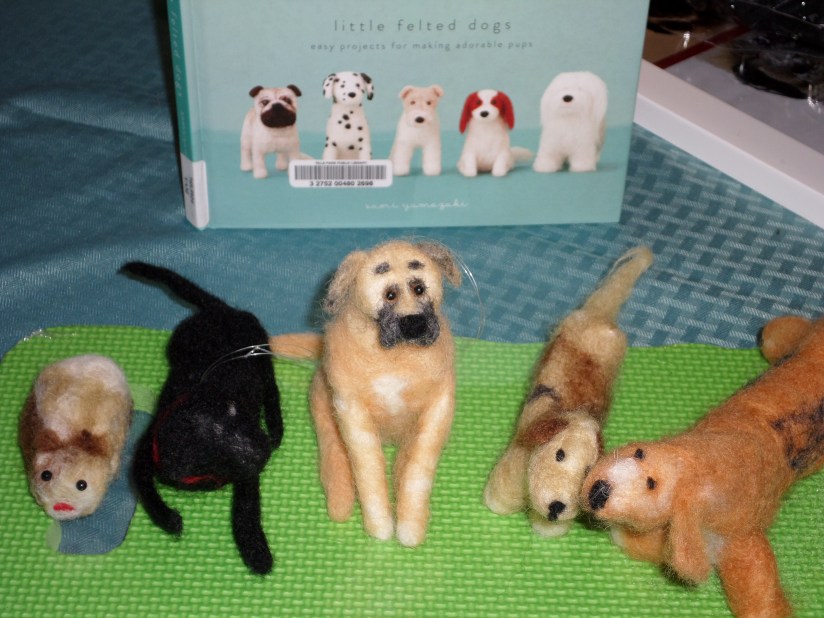
This was a group Interlude, with my friends Pam and Daniele, and Daniele’s daughters, Marion and Emilie. Daniele had seen a book about needle-felting dogs, and since both she and Pam are loving dog moms, we made this our project.  None of us had any experience with needle-felting 3D figures, and I’ve had minimal tries at felting onto a surface, so this was sure to be interesting.  Going into this, I kept thinking of that old tale of the blind men and the elephant, each man touching a different part of the elephant and therefore having a totally different description of what an elephant is.  I knew we each were going to approach this with our own abilities, our own perspectives, and quite possibly have a taste of the blind leading the blind.  It was all that and more (!), and we thrived in our goal to have fun.

SAMSUNG CAMERA PICTURES

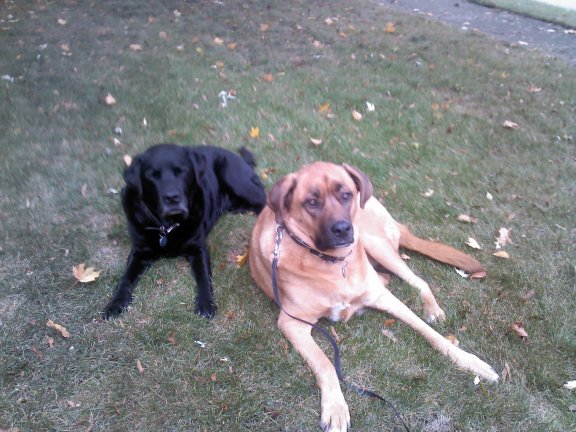
We started with two books about needle-felting, Fleece Dog and Little Felted Dogs, and plenty of supplies: wool roving, felting needles, foam bases and shaping wires.  We also had reference photos of their dogs, Pam’s two current dogs and Daniele’s current dog as well as her former one. Pam and I worked on replicating her dogs, and Daniele and Marion worked on hers and Emilie played at being Prometheus and created a wool-person from scratch.  We were focused, and fruitful.  Here are a few highlights to our learning curves:

  • Despite the small gestures involved in needle-felting, it can be surprisingly impaling to the fingertips when you try to hold your sculpture up to work on it, rather than set it on the foam base.  Fortunately, wool is absorbent, and truthfully, we did quite well at being wound-free.
  • Felting needles break easily, 3 of our 6 needles met their maker by the end of the day.
  • Felting up a big wad of wool goes surprisingly quickly, and is remarkably satisfying to see it go from blob to dog shape.  But long skinny bits, like legs and tails, not so easy, not so fun.  We learned the fibers can’t all be in one direction, you need crosshairs to make the skinny bits hold their form.
  • This was my favorite learning curve; despite all of us being book people and library people, and being prepared by having instruction books on-hand, somehow it didn’t actually occur to us to open up the books we had until we were done with our creations.  Which goes to show, sometimes you go with the book learnin’ and sometimes you just dive in and have the experience you’re going to have.

Back to Essence.  If we wanted to create a truthful dog image, we would have aimed for photo-realism (just look on etsy and you will see amazingly real-looking dog and animal wool sculptures.) But our skill set at this point wasn’t there.  So as we worked, we had to keep making choices as to what level of truth would be told.  Were we aiming for personalities of the dog, for breed, for postures of the dog, or for general coloring and shape?  It quickly became a matter of finding and sharing the Essence of the dog.  As Creators, could we each look into what we made and recognize the dog we know?  Is its heart in the right place?  Are the legs in the right place? And for our viewers, will they be able to look upon our creations and know to whom, or at least to what, we lovingly refer?  Truth and Essence are a bit of a negotiation between what we want to share and what we are capable of sharing.  As well as what we want to perceive and what we are capable of perceiving.

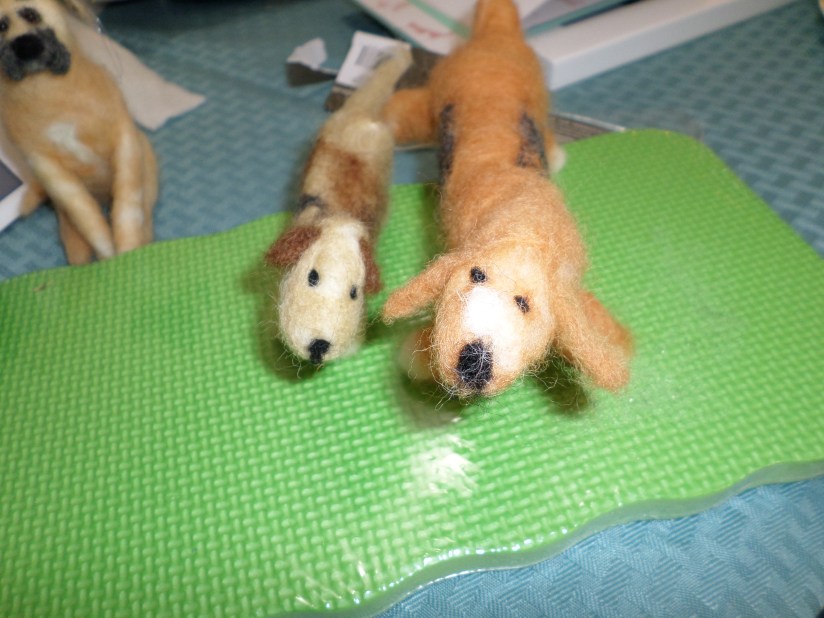
Daniele’s dear dog perhaps made the greatest leaps in evolution, from essentially being a banana, to being a seal, to a quadruped mammal, to a bear, to a fox, to a dog, and finally, to being her dog.  It was a beautiful transformation, from the unknown into the known, and eventually into the beloved.  (And from end to end, because at one point she decided that what she was working on as the head, would make a better tail, so the whole little guy flipped ends.)

20180304_175204

SAMSUNG CAMERA PICTURES
Marion and Daniele’s pooches

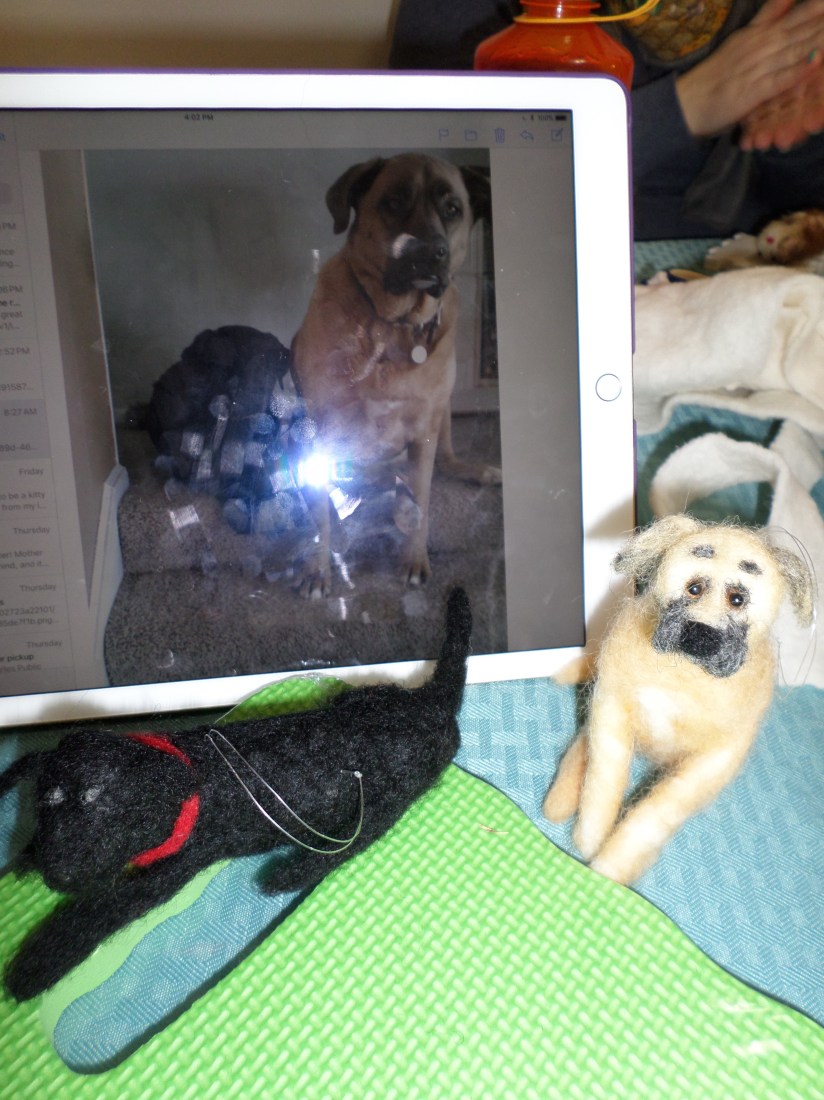
Pam’s little darlings are actually larger-sized dogs.  We didn’t start with a wire armature for these.  They both were in a sitting position, which worked well for us as we soon discovered how hard it was to densify the felted wool for the legs.  The dogs really started to become themselves once we added ears and coloring.  Pam’s big challenge was the black-on-black of her labrador, so she wisely chose to offset the eyes with a lighter color, and gave him a kicky collar! And look at that happy-to-see-us tail!

2013-11-05 11.43.42

SAMSUNG CAMERA PICTURES
Pam’s dogs became ornaments!

Marion mastered her pup (see the smaller dog alongside Daniele’s in the photos above) and so created another fellow, a guinea pig!  And, as adorable as the real thing.

Yea! We used community to have some fun and see ourselves as Artists and Creators.   And now we know, we have talents that only ever ask to be expanded and explored, we have innate wills to create and a whole world to fill with our creations, and we have the power to imbue our joys in life into a million little things that will keep reflecting that joy back to us.  We Are….Success!

All of that, from a willingness to see something heartfelt in a few locks of wool.