The Vast In-Between

Some years ago I had seen a video that showed the relative distances from the largest known phenomena of the universe to the smallest.  It became a paradigm shift for me because of how much space and distance it showed that exists in the subatomic realm.  Despite our inability to physically see it, the inner space of our presumed forms is vast, and rife with potential.  I couldn’t find the video I saw, but here is one that is similar:

It is easier for the imagination to amplify its senses out into the galactic realm, mostly because it is observable, and seems to enlarge with every step.  But when we imagine into our forms, we think in terms of reaching the smallest spaces of ourselves, and that limitation is because of our point of perspective. Is it possible to reach within, and experience that vast, mostly unoccupied space that’s hidden within a form, commonly understood as being a subatomic space?

Lately, I’ve been taking walks into my subatomic self, as a sort of meditative daydream.  It has been an interesting exercise because I am doing my best to keep this out of my mind’s influence.  I don’t want to think my way through the walk or to think about what I will find.  I just want to take the walk, and have that experience.  I have discovered that parts of my body have specific climates (perhaps like the damp or fiery descriptions found in Chinese medicine), have inhabitants (with voices and emotions), are notably loud or silent (no digestive jokes, please), are clearly of the Earth or are galactic and in a few cases, are like a vortex that leads me someplace that I can’t even relate to being of my own body at all.  My walks are to explore the potentials residing in my form.

This started because I have reactivated a chronic foot issue that leaves me impaired and lame for weeks while it heals.  It’s an old story in my life, an old pattern in my body.  I’ve tended this in a million other ways; every time it presents I regard it with something different.  So this time, with total acquiescence, I decided to go subatomic and see if there’s a Choose Your Own Adventure here that could lead to some new endings.

Making choices in this inner space story isn’t what I thought it would be.  It isn’t about how the story branches into a plethora of endings.  Despite my expectations (i.e. my mind’s way of doing things) there is nothing linear about this.  It is all about going multidimensional, seeing how the story exists through many layers, feeling it out as you go.  Molecules may be too personal a structure for seeing the story objectively, so start with the atoms.  Does the cast of characters lie in the atom?  Is there a separate backstory with each electron or various quark?  Is the plot driven by bosons?  Each of these things is in a world of its own, yet they all add up to tell a tale that becomes the world I live in, to be the story that is told through me.  Every littlest bit adds depth, fleshes out the story.

As far as my foot goes, it starts with pebbles in my feet….it starts with forgetting to separate myself from the earth I walked upon….it starts with remembering I used to be pieces of the earth….it starts with “In the beginning……”
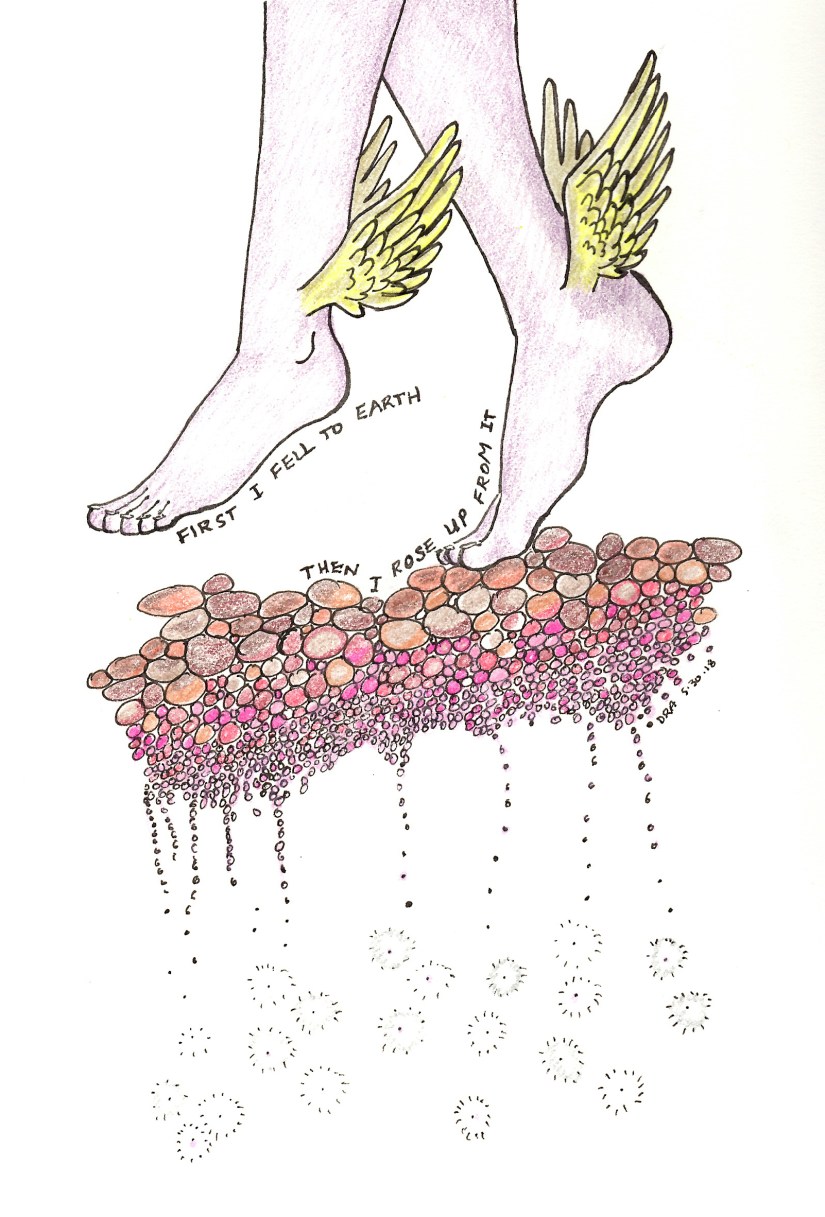
earthrise


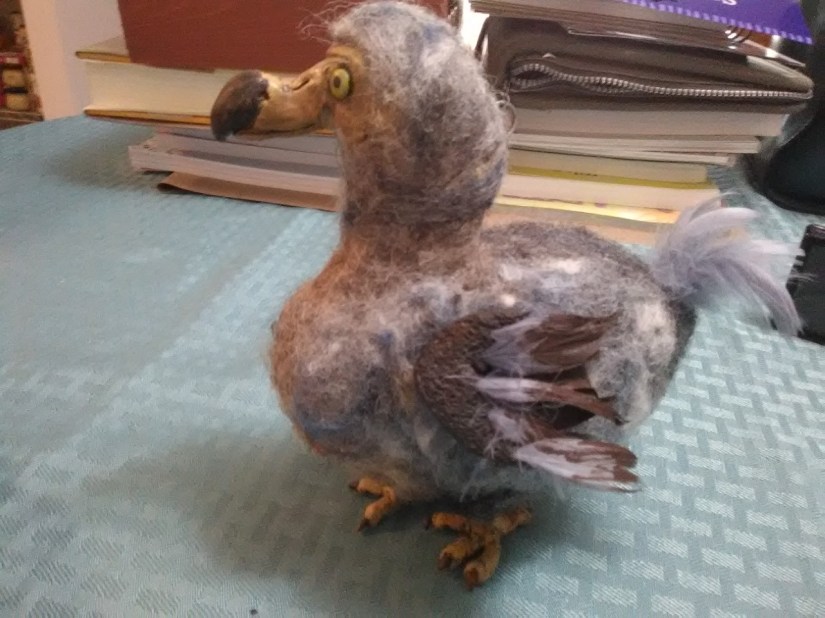
Taxidermy Needle-Felted Dodo

Supplies:

  • styrofoam
  • floral wire
  • polymer clay
  • acrylic paints
  • ModPodge, matte or gloss finish
  • thick sheet of wool felt
  • wool roving
  • needle-felting needle
  • feathers
  • hot glue gun and glue sticks

Yes, that’s right.  We’re doing a dodo.  I have a “Natural History” display cabinet, and it has been needing a dodo.  I had been imagining simply sculpting one from the polymer clay, but I had concerns that it might be top heavy and keep tipping over.  I happened to see the video in my previous post , and happened to have a bag of feathers and a styrofoam disk, so I decided to create an armature and build my dodo as a taxidermy project.

The styrofoam disk is from the dollar store, and I cut it into thirds.  Then I paired two of the wedges, honed their shape a little more and created a couple of staples from the wire to hold it together.  Then I rolled the sharp edges on the table to round them out.  This became the body base of my bird.

The next to come was the base for the feet and beak.  I formed the wire into basic dodo foot shapes, and made sure I had prongs leading from the top of the feet so I could press them into the body base later.  Then I shaped a base for the face and beak, also including attachment prongs.  This was a great way to use an obnoxious orange clay I had from another project.  I overlaid the clay and detailed it to make a flashy pair of feet and a beak.  After baking the clay, I painted and clear-sealed it.

Now comes the taxidermy (in a very faux sense of the word).  I accidentally deleted a few of these photos, so I can’t show you the process of adding a styrofoam neck base to the body, or of cutting sections of the wool felt sheet, then hot gluing them onto the foam base. Unlike real taxidermy, I wasn’t concerned with mounting an entire pelt around the body base, so I was free to cut and align smaller sections of the felt.  Also, in deciding the arch and shape of the neck, I kept holding up the face piece to get an angle that I liked.  When applying the felt, I was careful to press it up against the face piece so I wouldn’t have to needle-felt any patches in that area later.

My photos for the finishing steps were also lost.  So please employ your imagination for this part.

I felted roving around the bird, to add color, smooth out my base felt patches as well as to fatten the body up.  I had to stab gently with the needle, and often at a severe angle because I couldn’t stab into the styrofoam base (it was too hard) and I did not want to break my needle.  So I was careful to only poke into the felt base (and that is why it helps to have a thicker sheet of felt to begin with – the one I used is carried at both Hobby Lobby and Michael’s.)

I experimented with a lot of things to make the wings.  I was out of polymer clay so I shaped thinner slivers of the styrofoam that I had left onto a wire, heavily painted them, and was easily able to poke a few layers of feathers into the foam.  I used an awl to make a guide hole through the felt layer of the body, then pressed the wings onto the body.  A few feathers became a tuft of tail, and my little display dodo was complete!

dodo

My dodo is now a cherished part of my Natural History cabinet, as well as a reminder to cherish and support the well-being of the many bird people who currently fill my life.

Evolving Into the Familiar

I will link a video at the end of this post.  It is about an artist who fuses animal pelts with human facial features.  I’m putting it at the end because if taxidermy/using animal skins makes you uncomfortable, you can avoid seeing the video.  It also may be uncomfortable seeing a human face in an animal context, (I find it both alarming and enthralling.)

In my last post, The Traveling Eye, part 2, I commented on retraining the eye out of habitual visual depths, in order to freshen both your awareness as well as creative vision.  (And possibly to benefit your physical vision.)  I watched this video recently and it has me thinking in a tangental direction.  Instead of having a perception filter that reduces what we see into something familiar, and therefore less apt for acute attention, what happens when we explore with a filter that details our own image/self onto what we see?  Does it become endearing, because we see ourselves in it?  Is it revered?  Or does it unsettle?  How much of ourselves are we willing to see, in the world around us?

A quick perusal of art, architecture and crafts shows how we love to see our image portrayed through and onto almost any medium.  And literature abounds with anthropomorphized fauna, flora and objects, to our delight and entertainment.  But when the human image, merged with other aspects of nature, gets a little too real, some discomfort arises.  The image becomes unnatural. And our reactions to that unnatural image are what I find exciting to explore. Who am I when I’m in the middle of an emotional reaction to a simple image?

It doesn’t even take a full-on human face applied to an animal form to summon that reactive revelation.  There are two books of primate photos I recommend, to evoke reaction.  One is “James and Other Apes” by James Mollison (its cover is the chimp photo below) and the other is “Monkey Portraits,” by Jill Greenberg.

I want to clarify, I am not advocating exposure to extreme types of things just to feel horror, or be grossed out (or actually, to feel anything).  Main stream culture and media have that covered all too well.  I am talking about reactions to things that are not so obvious.  For example, in the “James” book, when I pay attention to myself as I see its images, why would I feel such vulnerability, or fear, or awe, by a simple close-up view of a primate face?  Why would I be moved to tears?  Why would I want to give a particular ape a hug?  Apes are that gray space between the human image and an animal image, it’s an easy segue and easy to relate to.  But why would I be feeling what I feel when there’s more contrast in the paired images?

In time, I’ll continue my thoughts on this.  For now, here’s the video.  And, I accidentally deleted some photos that documented my steps in creating a Taxidermy Needle-Felted Dodo, but I’ll include what I have in the next post.

https://www.kateclark.com